

With the latest events that have taken place in the news of our “world” [a social media giant changed its name as it relates to what it feels its new path is taking with the creation of a “metaverse”, and the significance of it all scripturally], I found myself pondering over what I had now been led to consider as I read Psalm chapter 11.
“In the LORD I put my trust;…”
That is a given. I fully agree with the Psalmist here. I cannot see any other way. I have had too many life experiences of what happens when I step out, and do my own thing, versus what happens when I entrust my day, every day, and all that I do within it to the LORD. There is just no way that I can justify not trusting the LORD fervently from my heart, with all that I am, and all that I have – whole heart, whole mind – whole soul.
“How can you say to my soul, ‘Flee as a bird to your mountain’?…”
Looking at the first section, I wanted to make sure that I understood what “my soul” is that was being spoken to. You see, I just realized that even when I said the above about “trusting the LORD fervently from my heart, with all that I am, and all that I have – whol heart, whole, mine – whole soul” that I didnt frfr know what I was saying. I didn’t really understand what “the soul” was/is, though I understood the context of what I was saying. Is that good enough?
I had to sit with this for a moment to make sure that I understood what the Psalmist was saying here. So I took the time to break it down into sections: A) How can you say to my soul, B) Flee as a bird, and C) to your mountain.
Is it good enough to understand “the context” of what one is reading and thus declaring…, as opposed to fully understanding each component of what one is reading and declaring…?
I felt led to stop and correct this immediately by making sure that I understood more than the surface of what I was reading. Something in me knew that this correction in understanding was necessary. In seeking understanding, I considered several verses in the Bible starting with the very verse that was behind the statement that I so freely made.
- Matthew 22:37 which references the heart, soul, and mind
- Luke 10: 27 which references the heart, soul, strength, and mind
- 1 Thessalonians 5:23 which references spirit, soul, and body
Now, in my considering each of those verses, it was not for the context in which each verse was written. Instead, I was looking to distinguish the difference between the soul and the spirit. This is because that was the reason I began to question whether I really understood that which I was claiming.
It turned out to be the verse at 1 Thessalonians that helped me to find and prove that there was a difference. By seeing the reference to the spirit, soul, and body, this led me to find that there are different Hebrew words used to describe the soul and the spirit.
The Hebrew word for soul is psuche. The Hebrew word for spirit is pnuema.
I began to understand that the spirit, the pnuema, is in constant communication with our Heavenly Father. Whereas, the soul, the psuche, is our personality (our character, temperament, identity, our attitudes, and patterns of feeling, thinking, and behaving). So, the heart is the seat of motivation, it represents the depth of what I believe and feel; mind represents my understanding and thought processes; and the soul is my personality. Now that I understand that the soul has to do with the individual personality, one’s character. I can now look at the next section,…
“Flee like a bird to your mountain…“
The NKJV Study Bible reference for Psalm 11:1 mentions that a bird is a defenseless animal that can only fly away rather than stand its ground and fight. We see that every day around us when we encounter birds. If we get too close to them they will fly away. So that part of the statement is not what stood out to me. What had captured my attention, causing me to “dig deeper” was the phrase ‘to your mountain’. What did this mean?
I set out to google that phrase, which is one of my favorite things to do when studying because google will pull up everything written on the subject that you are searching, and then it is then up to you to sift through all that comes up and discard, like chaff, that which does not apply. So I first define it. Then I look for the significance in mountains and nothing is striking me. Recognizing that if I want a different answer I need to ask a different question, so I ask, “What does it mean to go “to your mountain”? This is where I realized that I have tapped into what could potentially help me to understand what the Psalmist was thinking when he wrote:
“How can you say to my soul (my character, my personality) Flee as a bird (meaning to back down and not fight or defend oneself) to your mountain?” What was the significance of fleeing to one’s mountain?
Psalm 11:1
Research led me to find an outline of a note provide in the Sage Journals on the location of Moses in Exodus chapter 19 which revealed that he was up the mountain when he was communicating with God (revealing the peoples response to God and hearing what to speak to the people from God), and he was down the mountain when he was communicating with the people (relaying to the people what thus says the LORD). From verses 3 to verses 25 Moses is seen going up and down the mountain communicating “like a courier” between God and the people.

Pondering over this first verse, I realize that the Psalmist was reminding himself and others that he was not defenseless in the situation at hand.
Considering what the situation was, King David ran with his family and children when his son Absalom staged a coup. He didn’t stand and fight against his son as he had fought others from other nations. He fled and allowed his son to take over Jerusalem. In verse number two, he spoke about the arrows of the wicked shot “secretly at the upright in heart”. This is what clued me in as to what was possibly going on. I wonder if, by this time, David understood the anger of his son against himself that would cause his son to rise up against him the way he did. I also wonder if David again recognized this to be a result of an err he made in sleeping with Bathsheba, and then having her husband killed so that he could marry her to cover over the fact that he got her pregnant. I wonder this because of what David asked in verse #3. He said,
“If the foundations are destroyed, What can the righteous do?“The foundations were definitely destroyed in David’s home, but there is more to this scripture than the surface of what I understand. I know this because this metaverse that has now been created that is changing Facebook over to a company called Meta is no small matter.
“By faith, we understand that the universe (worlds) were framed by the word of God so that the things which are seen were not made of things which are visible.”
Hebrews 11:3


The universe is defined as all existing matter and space considered as a whole; the cosmos, infinity; it is a particular sphere of activity, interest, or experience, world. The suffix: -verse denotes an area of activity or interest or a section of society distinguished by a particular characteristic. So, our Heavenly Father GOD created this universe for us (see Genesis chapters 1 and 2); and, well, look at the condition of our earthly home. By the way, uni- means one. Meta means many.
If we have been poor stewards of the universe in which we live, what makes us think that we cn be better stewards of a metaverse.
There are so many articles that have been written and are online even now about this new Metaverse that facebook is now focusing on. You will have to google it because my post is not designed to stir up feelings and give stage to what ChanZuckerberg is doing with Meta. Instead, it was this very issue that cause Psalm 11:3 to stand out to me as I read and meditated upon God’s Word.
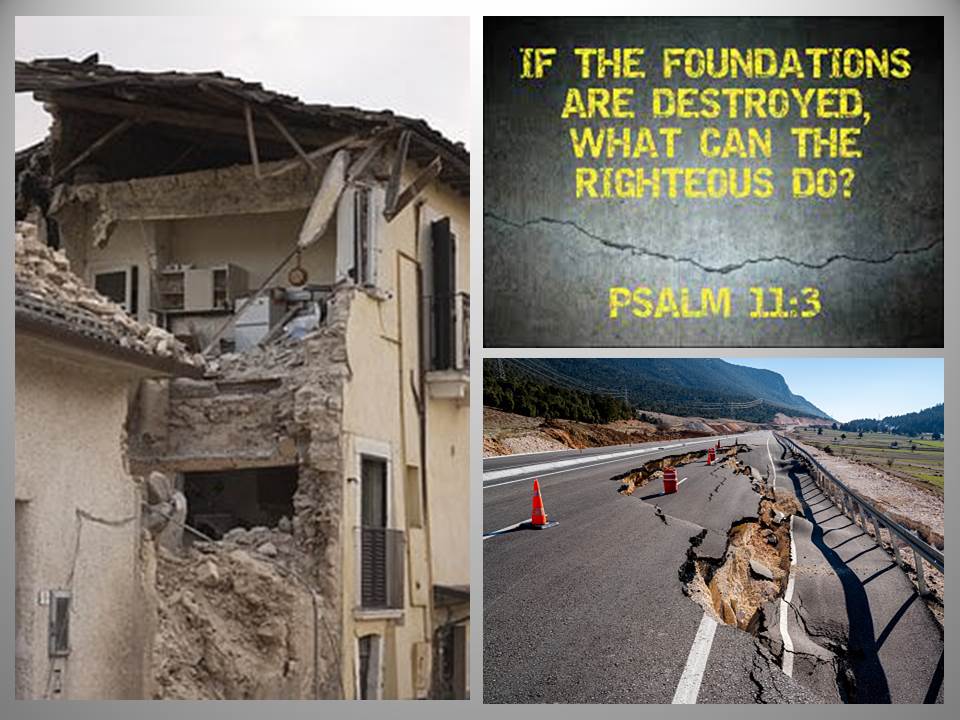
Foundations are destroyed and are continually being destroyed right under our noses. Nevertheless, I take comfort in the fact that King Jesus warns us ahead of time and prepares us. While the question is asked, what can be done when the foundations are destroyed; know that an answer is given too. In my journey to search for this answer I found myself considering closely all that Father had to say in his written Word about foundations for I firmly believe tht the answer to everyone question and concern that we may have can be answered by God’s Word. Here is a list of some of the verses that we will be considering in reference to answer the question raised in Psalm 11:3.
- Matthew 7:24-27 If we listen to what King Jesus tells us and do it; then, he likens that to a wise person who builds our home on a rock (meaning that the condition is stable when God’s wrath comes we will be able to stnd thru it.
- Luke 6:46-49 Piggybacking off of Matthew’s statement about the builder, Luke adds that this person is one who builds by digging deep until he is able to lay his foundation on rock. It is said that he will withstand the storms of life that come at him. Also I would be negligent if I was wo leave out the importance of understanding that these storms refereneced in these verses are refrences to divine judgments.
- 1 Corinthians 3:10-16 We are God’s building. The foundation is Jesus Christ. When we build upon others and ourselves, the type of building materials that one has used is made evident through our ability to withstand the testing of our building. We are told each ones work will become clear. It will be revealed by fire and tested for what sort it is. How are you building? Will you be rewarded for a job well-done.
- Isaiah 28:16 This tells us a couple of things. It tells us that Jesus is this “tried stone, precious corner stone, a sure foundation.” Then it tells us that , “whoever believes will not act hastily.” One who acts hastily is one who acts out of fear. But when Jesus is your foundation, he is tried, tested and true. He is stable.
- Matthew 6:18 We are reminded that our Father is in the secret place (secret in that many are not digging deep to be rooted in him); and that though HE sees from this secret place, HE rewards openly. So where we interact with HIM in secret, when HE rewards us, HE does so openly where averyone can see.
- Jermiah 29:11HE tells ut aht HE knows the plans that HE has for us, thoughts of peace and not evil , to give us a future and a hope.
- 2 Timothy 2:19
- Ephesians 2:19-22
- Ezra 3:11
- 1 Peter 2:4-6
- Psalm 118:22
- Philippians 4:13
- Isaiah 66:1-2
- Ephesians 2:10
- John 13:35
- 1 Kings 5:17
- Acts 4:11
- 2 Peter 3:16
- Psalm 18:2
- Colossians 3: 12-14
- Dueteronomony 28:6
- John 1:1
- Matthew 21:42
- Joshua 6:26…
I thought I posted this already. This is what inspired my study of foundations and here is the list of scriptures that I will be digging closer into.
 Between a Father and HIS daughter